
The Revenue Recovery Framework: Why Small Businesses Fail the Productivity Test in 2026
For the contemporary small-to-medium business (SMB), the primary obstacle to growth is rarely a lack of market demand. In fact, homeowner spending on maintenance is projected to reach $608 billion in 2025. The crisis is a "productivity paradox": while AI tools are ubiquitous, service sector productivity remains stagnant, growing at only 1% annually.
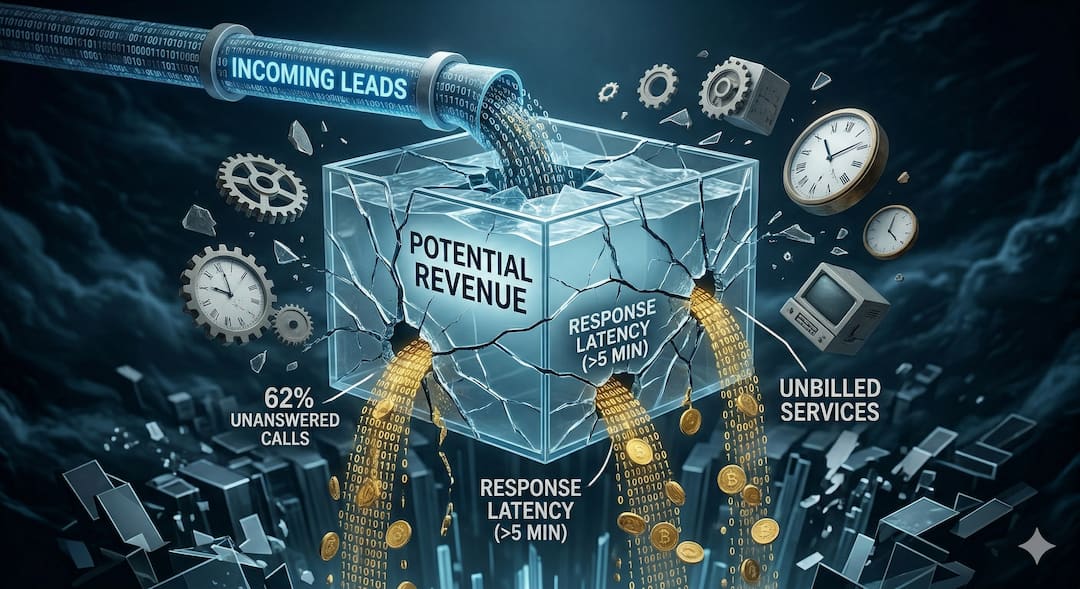
The issue isn't that businesses aren't working hard; it's that they are "leaky buckets". High activity levels are often masked by systemic operational failures, leading to a state of being "busy but broke".
The Architecture of Revenue Leakage
Revenue recovery is the discipline of regaining lost or at-risk income caused by operational friction. For service-based SMBs, the product is time-perishable; a missed interaction is not an oversight—it is a permanent loss to a competitor.
| Leak Category | Systemic Symptom | Financial Impact |
| Intake Failure | 62% of calls go unanswered; 85% do not call back. | $126,000 avg. annual loss. |
| Response Latency | Qualification rates drop 10x if response exceeds 5 mins. | 79% of marketing leads never convert. |
| Invoicing Delays | Manual billing sent weeks after service. | Increased risk of "credit rationing" by banks. |
| Unbilled Services | On-site "scope creep" missing from final invoice. | 2–5% erosion of total net profit margins. |
Phase 1: Front-End Recovery via Multimodal AI
The phone remains the dominant channel for high-intent inquiries, yet small businesses answer only about 38% of incoming calls live. Traditional IVR systems often fail because of robotic delays (3-5 seconds) that cause high-intent callers to hang up.
Professional-grade recovery requires a Multimodal Stack:
- Intelligence Layer: Utilizing APIs like Gemini Multimodal Live for real-time, bidirectional voice processing. This allows for "Barge-in" capability, where the AI can be interrupted and pivot mid-sentence just like a human receptionist.
- Latency Mitigation: Implementing an "Agent Speaks First" protocol to greet callers immediately, preventing the 2-second silence that triggers a hang-up.
- Cost Efficiency: An AI receptionist represents a 93–95% cost reduction compared to human staff while providing 4.2x more coverage hours.
Phase 2: Middle-Funnel Resilience with Automation
Capturing the lead is only the first step. Revenue is often lost in the "middle of the funnel"—the gap between intake and a scheduled job. Workflow automation (via platforms like n8n) acts as a deterministic "Revenue Command Center".
High-Impact Automation Blueprints:
- Instant Text-Back: Triggers an immediate SMS when a call is missed or a form is filled. This triage captures 30–40% more leads than standard callbacks.
- Estimate Follow-Up: Automating nudges at 1, 3, and 7 days after a quote. Properly implemented CRM automation can increase job efficiency by 35%.
- Order-to-Cash Sync: Extracting job details from field apps (Jobber, ServiceTitan) and pushing them to accounting software (QuickBooks) within minutes of job completion.
The Economic Reality: ROI Benchmarks
Revenue recovery is not a speculative investment; it is a deterministic calculation.
| Industry | Revenue Exposure per Missed Call | Annual Lost Revenue (Est.) |
| HVAC | $350 - $1,200 | $91,000 - $189,068 |
| Plumbing | $325 - $650 | $125,000 - $165,000 |
| Roofing | $1,500 - $3,500 | $364,000+ |
| Legal | $5,000+ | $250,000+ |
Conclusion: Moving Toward Operational Excellence
Small businesses in 2026 do not need more "leads"; they need to stop the bleeding in their existing operations. By shifting from a "busy signal trap" to an automated, high-fidelity system, owners can move away from manual workarounds and toward "buying back their time".