
The previous post established the architecture of revenue leakage — the systemic failures that cost local service businesses an estimated $126,000 annually in missed calls, slow follow-up, and billing gaps. The diagnosis is clear. What remains is where to intervene first.
The answer is the five minutes immediately following an inquiry.
The Number That Changes Everything
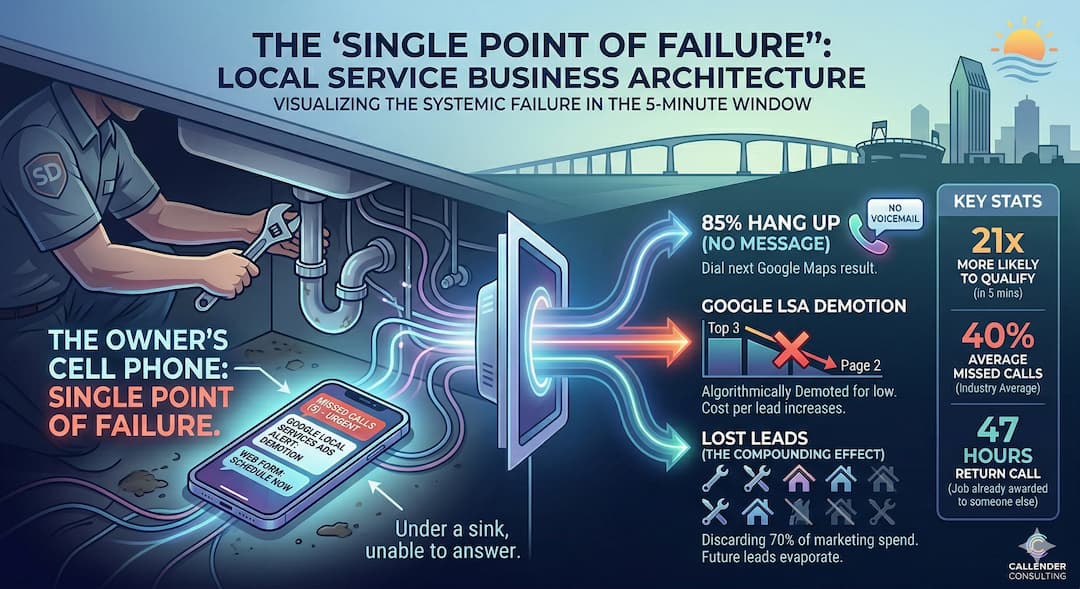
A lead contacted within five minutes is 21 times more likely to qualify than one contacted after 30 minutes. After an hour, that probability drops by another 60%. By the time the average service business returns a call — which takes 47 hours — the job has already been awarded to someone else.
The problem is not awareness. Most owners know they need to respond faster. The problem is that the five-minute window requires a response capability that a two-person plumbing team on a job site simply does not have. The business's response system has a single point of failure — the owner's cell phone — and that phone is under a sink.
What Callers Actually Do
When a high-intent caller reaches voicemail, 85% do not leave a message. They end the call and dial the next result on Google Maps. They are not disloyal. They are in a problem state and will give their money to whoever responds first.
For contractors running Google Local Services Ads, this compounds further. Google tracks answer rates. A business missing 40% of calls is algorithmically demoted in search rankings — paying more per lead for fewer visible placements. The missed call does not just cost the job. It costs the ad position that generated the next ten.
The Structural Fix: Decoupling Response from Availability
The five-minute window cannot be closed by working harder. It requires removing the dependency on human availability entirely. A properly configured front-end recovery system operates on three principles.
Immediate acknowledgment. The moment an inquiry arrives — by phone, web form, or SMS — the caller receives a substantive response. Not a voicemail prompt. An AI receptionist that answers on the first ring, speaks first, and captures the caller's situation without dead air.
Intelligent triage. An emergency plumbing call commands a 50–70% price premium over a routine service request. The system must distinguish between these cases — escalating genuine emergencies to the owner immediately while queuing standard inquiries for scheduled follow-up. Every call handled correctly. No judgment calls missed while on a job site.
Automatic lead preservation. Every inquiry must be logged, timestamped, and assigned a follow-up action. The average conversion rate for non-referral web leads is 30%. That means 70% of inquiries that arrive today will not convert on first contact. A system that does not preserve those leads is discarding 70% of its marketing spend.
What This Looks Like in Practice
Consider a roofing contractor running Google LSA campaigns at roughly $187 per exclusive lead. At a 25% close rate, each booked job costs approximately $750 in acquisition before a single nail is driven.
If that contractor is missing 40% of inbound calls — the industry average for roofing — they are discarding 40 cents of every lead generation dollar before the conversation begins. A front-end recovery system that answers every call, triages urgency, and captures lead data brings that miss rate from 40% to under 5%. The same ad spend produces more booked jobs. The cost per closed job drops. The LSA answer-rate score improves, which improves placement, which reduces cost per lead. Each improvement compounds the next.
This is not a technology story. It is an operational efficiency story in which technology is the mechanism.
The Practical Reality
The gap between businesses that have closed the five-minute window and those that have not is widening. Consumers who experienced instant, intelligent response during their last service interaction now treat it as the baseline expectation — not a differentiator.
For local service businesses in San Diego County, the question is not whether to build this capability. It is how long the current cost of not having it remains acceptable.
The next post in this series examines the back-end of the revenue lifecycle: the billing and order-to-cash failures that erode margin even after the job is booked and completed.
Callender Consulting works with local service businesses in San Diego County to identify and correct the operational gaps that cause lost revenue. [Schedule a conversation →]
Sonnet 4.6